Who Gets a Google Knowledge Panel? (And Do You Really Need 100K Followers?)
Short on time? Get the summary:
Or share it with someone who needs it:
I was meeting with my business coach today and he said something I just nodded along to: "As soon as I hit 100,000 Instagram followers, I get a knowledge panel."
I took it as fact. Then I got in the car and thought, wait. Is that true?
So I dug in. Here's the radically transparent answer on the Google knowledge panel: who it's for, where it came from, what feeds it, whether it actually makes you look more credible, and what's really going on with that 100K number. (Spoiler: he was half right, and the number already changed.)
The short version
- A knowledge panel is Google's fact box about a "thing": a person, place, organization or topic it understands.
- It's automatic. You can't apply for one or buy one. Google builds it from sources across the web.
- It started in 2012 with Google's Knowledge Graph and has grown to billions of entities.
- The 100K rule was real, but for something else: Google's new Search profiles. Claiming one may trigger a panel. And as of September 2026, the bar dropped to 10,000 followers.
- Followers aren't the whole story. Consistent information about you across trusted sites is what Google reads.
- A Search profile and a knowledge panel aren't the same thing. One you claim and customize. The other Google writes about you.
- For most local businesses, your Google Business Profile is the bigger priority.
What is a Google knowledge panel?
It's the box that shows up when you Google someone famous: a photo, a short description, key facts, and links to their website and social profiles. On a computer it sits to the right of the results. On a phone it shows up inside the results.
Google's own definition: knowledge panels are information boxes that appear when you search for people, places, organizations or things that are in the Knowledge Graph. They're automatically generated from various sources across the web.1
Google says a typical panel includes a title and short summary, a longer description, pictures, key facts (like when someone was born) and "links to social profiles and official websites."2
A quick history: "things, not strings"
In May 2012, Google launched the Knowledge Graph. The big idea, in the words of Amit Singhal, then Google's SVP of Engineering: a model that understands real-world entities and how they relate to each other, "things, not strings."3
Before that, search was mostly matching your words to words on a page. Search "taj mahal" and Google didn't know if you meant the monument, the musician, the casino in Atlantic City or the Indian restaurant down the street. The Knowledge Graph fixed that.
That 37% is the whole point of the panel. It answers the next question before you ask it.
Who is the knowledge panel for?
Google built it for entities people search for by name: public figures, authors, actors, musicians, athletes, companies, organizations, places, books, movies and topics. That's why most of the panels you've seen belong to famous people.
Google also says the people and organizations in panels are "self-authoritative," so it gives them ways to claim the panel and suggest edits.1
Business owners, read this part twice. If you serve customers at a location or in a service area, your version of this is your Google Business Profile. Google says Business Profiles look similar to knowledge panels but are specific to local businesses.1 For most local businesses, that's the bigger priority. It's the one that shows your reviews, hours and phone number, and it's the one that brings in calls. (Some businesses also have a brand knowledge panel. Both can exist.) (More on that in How to Get Found Online and Is a 5.0 Google Rating Good?.)
So the knowledge panel is really for you as a person or brand: the owner, the author, the speaker, the doctor with a book, the coach with a podcast.
Where Google gets the information
Google is pretty open about this:
- Wikipedia is a commonly cited source, "but it's not the only one." Google says it draws from hundreds of sources across the web, plus licensed data for things like music, sports and TV.2
- Open-source and licensed databases. At launch, Google named public sources like Freebase, Wikipedia and the CIA World Factbook.3
- Special coding on websites (structured data), like the markup that tells Google about an upcoming event.2
- The people themselves. Once you're verified, you can suggest edits and pick a featured photo.2
And it's not frozen. Panels update automatically as information changes on the web, and Google also takes feedback from the person in the panel and from regular users.1
The takeaway: Google is reading what the internet says about you. The clearer and more consistent your information is across the web, the easier it is for Google to understand who you are.
So, do you really get a knowledge panel at 100K Instagram followers?
Here's where my coach was half right.
On June 4, 2026, Google launched Search profiles: a page for publishers and creators that pulls together their articles, videos and social posts in one place. Google's announcement says claiming a profile "may trigger the creation of a knowledge panel for eligible publishers and creators," and if you already have a panel, it gets enhanced with your avatar, latest content and a profile link.4
Google's announcement just said you needed "a sizable following." The actual number was in Google's help docs at launch, as reported by Search Engine Journal: 100,000 followers on YouTube, Instagram or X, or 300,000 on TikTok.5 That's almost certainly where my coach's 100K came from.
But three things matter:
- The bar already dropped. On September 16, 2026, Google said it lowered the threshold to 10,000 followers across YouTube, Instagram, X or TikTok.6 Google's creator page now says 10,000 on a single platform, and that Search profiles are available in the US, Canada and India.7
- It's "may," not "will." Google's own page says if you claim your profile and don't see a panel when you search your name, it can be because other people or organizations have similar names.7 If you're one of a hundred "Mike Johnsons," followers alone won't fix that.
- For businesses and brands, it's different. Google says a business's panel stays connected to its Google Business Profile or brand profile.7
So the honest version is: hitting the follower bar lets you claim a Search profile, and that can get you a knowledge panel. It's not a switch that flips at 100K. And plenty of people have panels with no big following at all, because Google got its facts from somewhere else, like news coverage, a Wikipedia page or a book.
Search profile vs. knowledge panel: what's the difference?
This is the part that confused me at first, so let's make it simple:
A Search profile is something you claim and manage. A knowledge panel is something Google creates about you.
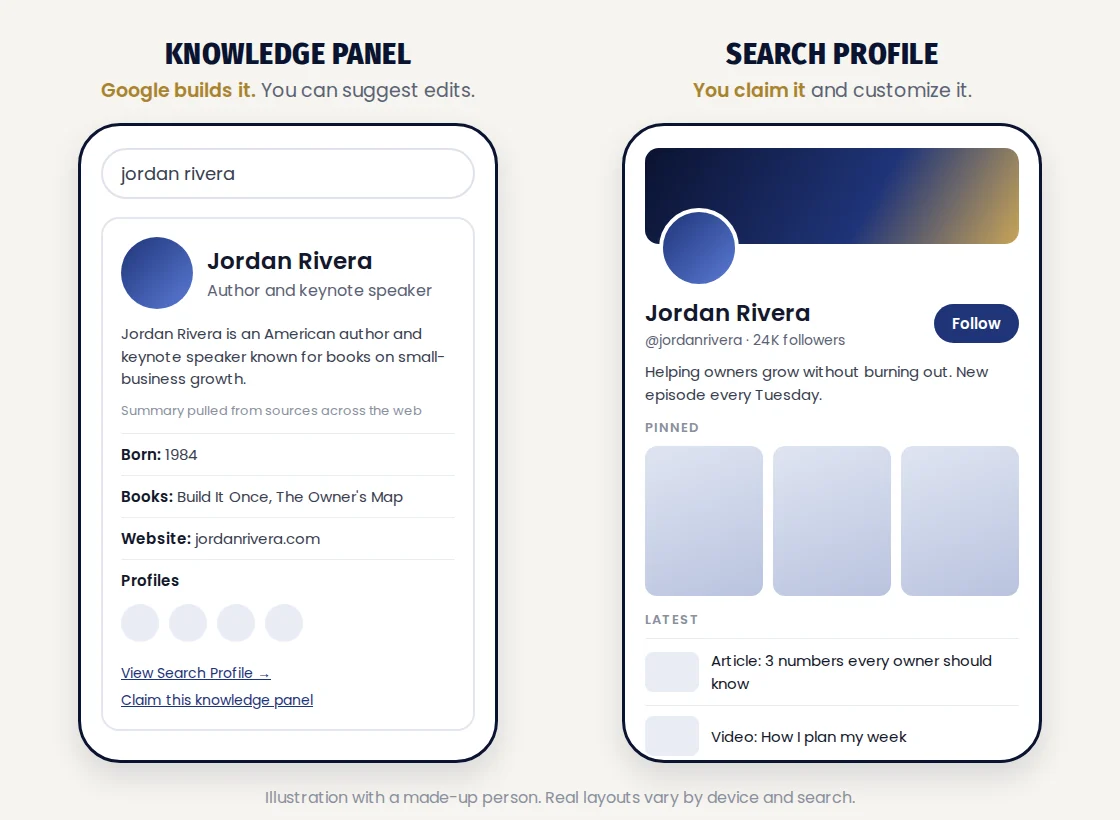
| Search profile | Knowledge panel | |
|---|---|---|
| What it is | Your creator or publisher page on Google | Google's info box about you |
| Who makes it | Google provides it, you claim and customize it | Google generates it automatically |
| Followers needed | 10,000 on one platform right now | No published minimum |
| How much control | You manage your photo, bio, links and pinned posts | You can suggest edits, not control it |
| What it shows | Your latest articles, videos and social posts | Your identity, photo, description, facts and official links |
| Who can get one | Anyone who meets the eligibility rules | Whoever Google decides is a recognizable entity |
They're connected. Claiming an eligible Search profile may help trigger a knowledge panel, and once you have one, the panel links to the profile.7 A Search profile also does something a panel doesn't: people can follow you, so they're more likely to see your content in Google Discover.4
And it's starting to show up in AI search. On October 15, 2026, Google said it's testing clickable creator and publisher names on video results in AI Mode that link straight to their Search profiles.8
If you remember one sentence from this post, make it this one: a Search profile is your home for content on Google; a knowledge panel is Google's summary of who you are.
How social media actually comes into play
Social media matters to the knowledge panel in three real ways:
- It's in the panel. Links to social profiles are a standard part of what Google shows.2
- It's how you prove you're you. To claim a panel, Google asks you to sign in to one of the official sites or profiles it lists: YouTube, Search Console, Twitter or Facebook.9 Interesting detail: Instagram isn't on that list, even though it counts toward Search profile eligibility.
- It's now a door in. Through Search profiles, your follower count can open the path to a panel, and your posts from YouTube, Instagram, X and TikTok can show up there.7
What social media isn't: a magic number. A big following with a fuzzy, inconsistent identity still gives Google a messy picture. If you're wondering which hat you're wearing on social, salesperson, influencer or business owner, start here.
Does a knowledge panel make you more credible?
I went looking for a solid stat like "X percent of people trust someone more if they have a knowledge panel." I couldn't find one from a source I'd stand behind. So I'm not going to make one up.
What I did find is research on news outlets, and it's mixed. One peer-reviewed study in Journalism & Mass Communication Quarterly tested transparency signals inside a Knowledge Panel and found none of the versions made people see the outlets as more credible.10 A later study by the same research group, with about 6,000 people in Brazil, Germany and the US, found that some panel details, like a description of the outlet, did signal that it was trustworthy.11 (That second study was funded by the Google News Project.) That's news brands, not business owners, but the honest read is: the details in the panel matter more than just having one.
Here's my take: a knowledge panel doesn't create credibility. It reflects it. It shows up because the internet already agrees on who you are. What it does do is clean up your first impression. When a prospect, a podcast host or a referral partner Googles your name, they get a tidy box with your photo, your story and your links, instead of a mess of old profiles and someone else with your name.
And as AI search keeps evolving, having clear, consistent information about who you are across the web is becoming a more worthwhile part of your online presence. Google's creator page even says panels tied to a Search profile will feature an AI-generated summary based on your bio.7 (Related: How to Show Up in AI Search and SEO Isn't Just Your Website.)
What influences whether you get one
Google doesn't publish a checklist, so here's what lines up with what Google has said: panels are built from consistent information across trusted sources, and you can verify and suggest edits once you have one.
- Be one consistent person online. Same name, same photo, same one-line bio, same title on your website, LinkedIn, YouTube, Facebook, Instagram and every directory.
- Have a real About page on a site you own that clearly says who you are, what you do and links to your official profiles.
- Get mentioned by others. Podcast interviews, local news, industry publications, speaking pages, a book listing. That's the "sources across the web" Google talks about.
- Check Search profile eligibility at Google's claim page if you're near 10,000 followers on any platform.12
- If you already have a panel, claim it and use Feedback to fix anything wrong.9
Be careful with anyone who guarantees you a knowledge panel. Google says panels are generated automatically, and even the Search profile route says "may." Nobody outside Google can promise the outcome.
What to do this week
- Google your own name in a private browser window. Is there a panel? Is it you, or someone with the same name?
- Line up your bios. Pick one photo and one sentence about you, and update your top five profiles to match.
- Check your follower counts against the 10,000 bar. If you're close on one platform, go see if you're eligible.
- Make sure your website's About page says who you are and links to every official profile.
If you'd like help making Google (and AI) clearly understand who you are and what your business does, that's exactly what we do at JDS1 Marketing. Or book a call with me and we'll Google you together.
Sources
Footnotes
-
Google Knowledge Panel Help, About knowledge panels. ↩ ↩2 ↩3 ↩4
-
Danny Sullivan, Google, A reintroduction to our Knowledge Graph and knowledge panels, May 20, 2020. ↩ ↩2 ↩3 ↩4 ↩5
-
Amit Singhal, Google, Introducing the Knowledge Graph: things, not strings, May 16, 2012. ↩ ↩2
-
Google, A new profile to help publishers and creators highlight their work on Search, June 4, 2026. ↩ ↩2
-
Search Engine Journal, Google Launches Search Profiles, Here's How You Can Get One, June 2026. ↩
-
Ibrahim Badr, Google, 3 new ways we're improving Search profiles for publishers, September 16, 2026. ↩
-
Hema Budaraju, Google, More ways to connect with the web from Search, October 15, 2026; details via Search Engine Journal. ↩
-
Google Knowledge Panel Help, Get verified on Google. ↩ ↩2
-
Journalism & Mass Communication Quarterly, study of transparency signals in Google's Knowledge Panel for news outlets. ↩
-
Masullo, Wilhelm, Lee, Gonçalves, Riedl and Stroud, New Media & Society, Signaling news outlet trust in a Google Knowledge Panel: A conjoint experiment in Brazil, Germany, and the United States, 2022. ↩
-
Google, Search profile claim page. ↩
Pass it on
Know someone who needs this?
Send it to one business owner who's been wrestling with this. It takes five seconds, and it might save them months. That's being kind to their future business.
Want a caption? Here's one, ready to paste:
Who Gets a Google Knowledge Panel? (And Do You Really Need 100K Followers?) My business coach told me he'd get a knowledge panel at 100K Instagram followers. I almost nodded along. Here's what's actually true, and what it means for you. Worth the read 👇 https://brentnickles.com/blog/google-knowledge-panel
Tip: on LinkedIn, add one sentence of your own take above it. That's what starts the conversation.
Keep reading
The Business Owner's Social Media Playbook: What to Do, What to Skip
Social media isn't your whole marketing plan, and it isn't nothing. Here's the simple system: what to post, where Google fits, what to spend, and how to know it's working.
SEO Isn't Just Your Website: Why Off-Page SEO Wins in the AI Era
Most people think SEO lives on their website. Google, and every AI assistant, is looking somewhere else: at what the rest of the internet says about you.